
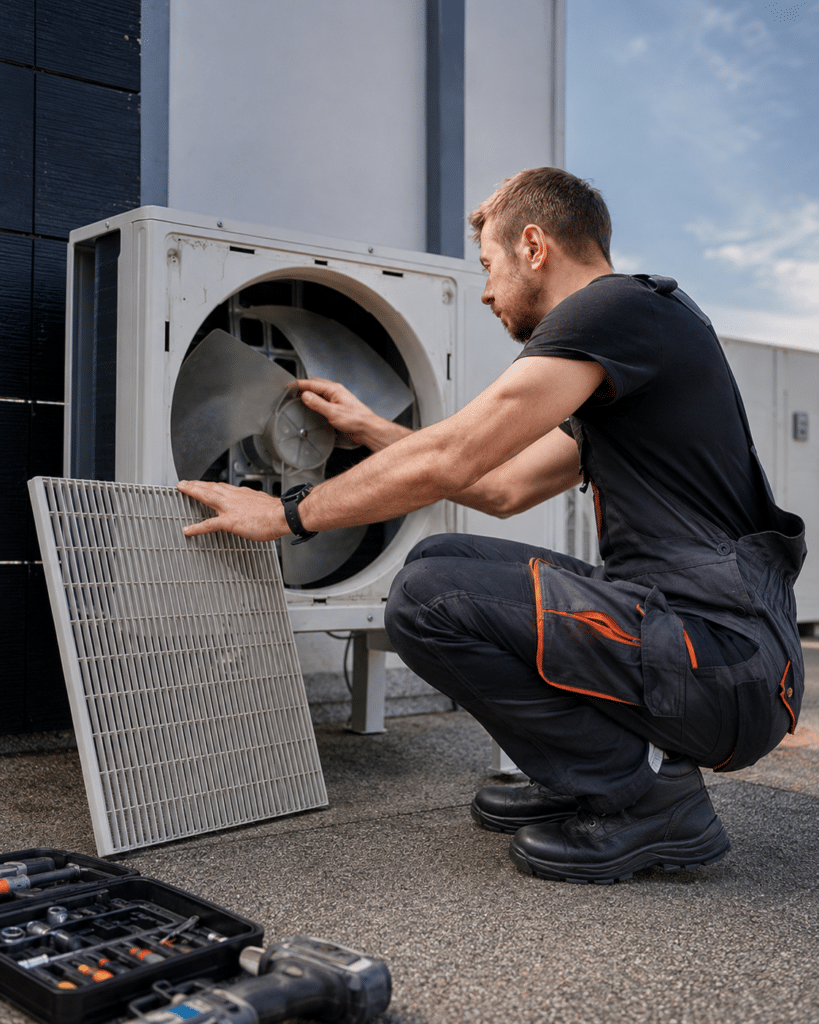
If your air conditioner is running but the house isn’t getting cooler, the most common causes are a dirty air filter, a frozen evaporator coil, a tripped breaker, low refrigerant, or a dirty outdoor condenser unit. In most cases, the system is still trying to do its job, but something is preventing it from moving heat out of the home. Some of these issues are safe to check yourself in a few minutes. Others need a licensed HVAC technician.
Here is what is usually happening, what you can check on your own, and when it makes sense to call for AC repair.
Quick Summary
- The thermostat setting, breaker, and air filter should be checked first
- A frozen coil or low refrigerant will keep an AC running without cooling
- A dirty outdoor unit blocks heat transfer and reduces capacity
- Repeated cycling, warm air, or short bursts of cool air usually need a technician
- Annual tune-ups catch most of these issues before they become emergencies
First Things to Check Before Calling for AC Repair
Before assuming the system is failing, run through a short list. These steps take a few minutes and rule out the simplest issues.
Thermostat settings. Confirm the thermostat is set to “cool” and not “fan.” Set the target temperature at least three degrees below the current room temperature. If you have a smart thermostat, check that a schedule or away mode isn’t overriding your setting.
Air filter. Pull the filter and hold it up to a light. If you can’t see through it, it’s too dirty. A clogged filter restricts airflow across the coil and is the single most common reason an AC stops cooling well. In most North Jersey homes, filters should be changed every one to three months during cooling season, more often if you have pets or run the system heavily.
Circuit breaker. Check the electrical panel for a tripped breaker labeled for the air handler or condenser. If the breaker tripped, reset it once. If it trips again immediately, stop and call a technician. A repeated trip is an electrical issue, not a reset issue.
Outdoor unit. Step outside and look at the condenser. Is the fan spinning? Is there visible debris, leaves, grass clippings, or cottonwood fluff packed against the fins? Clear anything within two feet of the unit so it can pull air freely.
If those checks don’t restore cooling, the issue is usually one of the causes below.
Common Causes When the AC Runs but Doesn’t Cool
Frozen evaporator coil. When airflow drops or refrigerant runs low, the indoor coil can freeze into a block of ice. The system keeps running, but the ice insulates the coil and stops it from absorbing heat from the air in the home. If you see ice on the copper line near the indoor unit, or water pooling under the air handler, shut the system off at the thermostat and call for service. Running it longer can damage the compressor.
Low refrigerant. Refrigerant is sealed in the system. If it’s low, there’s a leak. You can’t just “top it off” as a long-term fix. Symptoms include weak cool air, longer run times, hissing or bubbling sounds, and sometimes a frozen coil. A technician can locate the leak, repair it, and recharge the system to the manufacturer’s spec.
Dirty condenser coil. The outdoor unit releases the heat your AC is pulling from inside. If the coil is coated in dirt, pollen, or grass, it can’t transfer heat efficiently. The system runs longer, costs more, and doesn’t cool as well. This is one of the issues a standard tune-up resolves.
Capacitor or contactor failure. The capacitor stores the burst of electricity needed to start the compressor and fan motors. When it fails, the outdoor unit may hum without the fan spinning, or it may not start at all. Capacitors are wear items, especially after long humid summers, and they’re a common repair on systems eight years and older.
Ductwork problems. Leaky or undersized ducts can leave one part of the house comfortable while another stays warm. In older homes across Sussex and Warren County, ductwork was sometimes designed for heating only and struggles to deliver cool air evenly. A duct inspection will identify the problem rooms.
Oversized or undersized system. A system that’s too small can’t keep up on a 90-degree day. A system that’s too big short-cycles, never running long enough to pull humidity out. Both feel like the AC “isn’t cooling,” but the cause is sizing, not failure. This is something to discuss during a system evaluation, especially if cooling has been weak since the system was installed.
When to Call for AC Repair
Some symptoms are signals to schedule service the same day. Others can wait for a regular appointment.
Call promptly if you notice:
- Warm air from the vents while the system is running
- Ice visible on the indoor coil or refrigerant lines
- The outdoor unit humming but not spinning
- A burning, musty, or chemical smell from the vents
- Repeated breaker trips
- Water pooling around the indoor unit
- A sudden increase in your electric bill without a change in usage
For homes in towns like Sparta, Newton, Morristown, Parsippany, Madison, Denville, and Vernon, summer demand peaks fast once temperatures climb into the upper 80s and 90s. Service calls book up. Catching a problem early in the season usually means a faster appointment and a less stressful repair.
What a Technician Will Typically Check During a Service Visit
A standard AC repair visit usually includes:
- Verifying thermostat operation and settings
- Inspecting the air filter and airflow
- Checking refrigerant pressures and looking for leaks
- Measuring temperature drop across the coil
- Testing capacitors, contactors, and electrical connections
- Inspecting the condenser coil and fan motor
- Checking the condensate drain line for clogs
- Confirming proper compressor operation
A good technician will explain what they found, what is causing the problem, and what the repair options are before any work begins.
Why Routine Maintenance Reduces the Risk of Breakdowns
Most of the causes above show up gradually. A coil doesn’t get filthy overnight. A capacitor weakens over months before it fails. Refrigerant leaks slowly at first. A seasonal tune-up catches the early signs.
For North Jersey homeowners, the pattern that works best is a cooling tune-up in spring and a heating tune-up in fall. That cadence catches the issues that cause peak-season breakdowns, and it keeps the system running closer to its rated efficiency, which matters when summer electric bills climb.
If you’d rather not track tune-up timing yourself, the Service Partner Plan handles scheduling for you and includes priority service when something does go wrong.
Local Context for North Jersey Homes
Cooling problems in this part of New Jersey often share a few common threads. Older homes in towns like Newton, Branchville, and parts of Morristown sometimes have ductwork that was originally sized for heating only, which makes balanced cooling harder. Homes near the lakes in Sussex County deal with heavier humidity loads in July and August, which means oversized systems short-cycle and leave the air feeling clammy even when the temperature reads fine. Newer construction in Parsippany, Madison, and Denville tends to have tighter envelopes, which helps efficiency but also makes filtration and airflow more important.
None of these are universal, but they’re the kinds of details a local technician will consider when diagnosing why a system isn’t cooling.
Frequently Asked Questions
Why is my AC running but not cooling the house?
The most common reasons are a dirty filter restricting airflow, a frozen evaporator coil, low refrigerant from a leak, a dirty outdoor unit, or a failing capacitor. Check the thermostat, filter, and breaker first, then call a technician if those don’t resolve it.
Should I turn off my AC if it’s not cooling?
Yes, especially if you see ice on the refrigerant lines or coil. Running a frozen system can damage the compressor, which is the most expensive component to replace. Turn the thermostat to off and let the system thaw before scheduling service.
How often should I change my air filter during cooling season?
For most North Jersey homes, every one to three months. Homes with pets, allergies, or heavy system runtime should check monthly. A clean filter is the easiest preventative step a homeowner can take.
Is it worth repairing an old AC unit?
It depends on age, repair cost, and system efficiency. Systems older than 12 to 15 years with major component failures often cost more to keep running than to replace, especially when energy efficiency gains and available rebates are factored in. A technician can walk through repair versus replacement options during a service visit.
Can I add refrigerant to my AC myself?
No. Refrigerant handling requires EPA certification, and adding refrigerant without fixing the leak only delays the same problem. Low refrigerant always means a leak somewhere in the system, and locating and sealing that leak is part of a proper repair.
When to Reach Out
If your AC is running but not cooling, and the basic checks above haven’t fixed it, scheduling service sooner usually means an easier and less costly repair. Willco has served homeowners across Sussex, Morris, and Warren County since 1988, and same-day appointments are often available during cooling season for homes in the surrounding service area.
To schedule an AC repair visit or ask about a seasonal tune-up, request a service appointment through the contact page or call the office directly.